Modular, on-site technology converts industrial gas-cleaning residues into high-grade manganese products and valuable co-metals while eliminating hazardous waste storage liabilities.
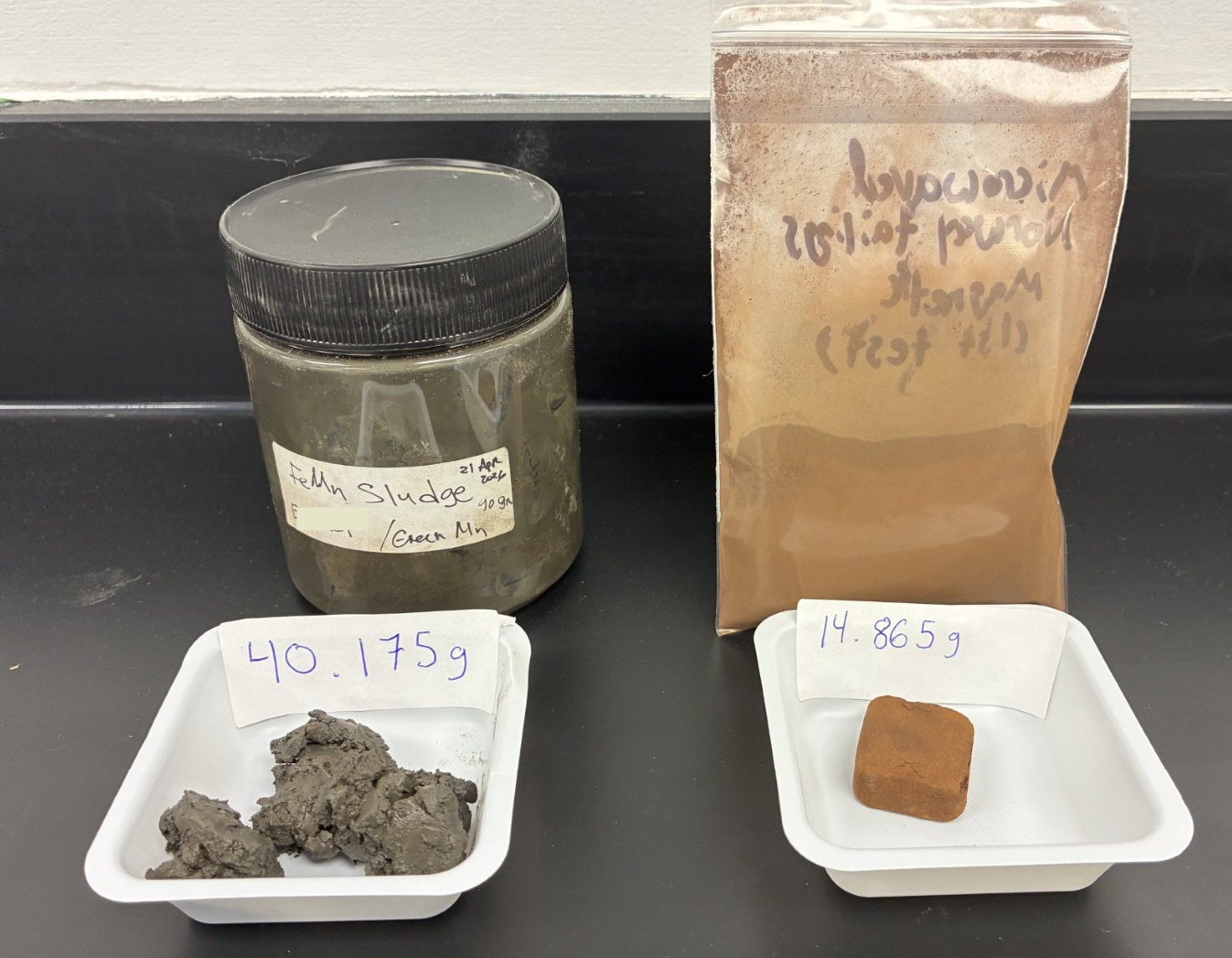
Green Manganese Technologies Inc. (“Green Manganese”) has successfully completed an initial processing campaign on wet gas-cleaning sludge from a European ferromanganese smelter. The results demonstrate a pathway to recover valuable metals while converting hazardous industrial residues into stable, near-neutral solids.
Independent testing by ALS Canada Ltd. confirmed a greater than 99.97% reduction in polycyclic aromatic hydrocarbon (PAH) concentrations in treated solids, demonstrating a significant environmental benefit alongside manganese and zinc recovery.
The findings address two challenges facing ferroalloy producers: recovering valuable metals currently lost to waste and eliminating the environmental and financial liabilities associated with sludge settling ponds.
High-Yield Metal Extraction & Material Neutralization
Initial feedstock characterization confirmed manganese grades of approximately 30% Mn and 6% Zn in the untreated sludge. Processing trials demonstrated high-yield manganese recovery and zinc extraction, confirming the potential to recover multiple valuable metals from a single industrial waste stream.
Beyond the primary target metals, the process separates hazardous heavy metals, including cadmium (Cd) and lead (Pb), into controlled process streams for further management. Alkali elements, including potassium (K) and sodium (Na), are also separated from the solid residue.
Independent analysis by ALS Canada Ltd. verified a greater than 99.97% reduction in total PAH concentrations in the treated solids, along with substantial reductions in Total Organic Carbon (TOC) and benzo(a)pyrene toxicity-equivalency (BaP TEQ).
Green Manganese’s process testing also demonstrated that the initially alkaline sludge (pH ~10.3) could be converted into stable, near-neutral solids (pH ~7) suitable for engineered backfill applications.
These results demonstrate the platform’s dual benefit: recovering valuable metals while neutralizing hazardous industrial residues that would otherwise require long-term storage and management.
“Our focus is providing smelters with a practical, double-benefit solution: treating ongoing gas-cleaning streams and historical sludge ponds right at the source, while recovering the contained metals.”
“By converting an environmental liability into a stabilized, high-grade manganese product, we eliminate wet-settling storage risks and create an ideal secondary feedstock to support lower-emission smelting.”
Significant Secondary Metal Recovery Opportunity
Manganese alloy production generates thousands of metric tons of metal-bearing sludge annually. Nearly every manganese smelter must manage these residues, often through settling ponds that require ongoing monitoring, maintenance, and environmental controls.
For example, published research on Eramet’s Kvinesdal plant in Norway reported approximately 10,000 metric tons of sludge generated annually.
Over time, these waste streams can form substantial above-ground deposits containing manganese grades of 25–32%, comparable to certain natural ore bodies.
A typical 500,000-metric-ton sludge pond grading 30% Mn contains approximately 150,000 metric tons of manganese before recovery losses, representing a significant secondary resource that can be reclaimed without additional mining.
The opportunity extends beyond manganese. Zinc concentrations of 4–7% in certain smelter residues offer additional co-product recovery potential, further improving the economics of sludge processing.
By recovering these metals while reducing waste storage and disposal requirements, Green Manganese enables smelters to transform an ongoing environmental liability into a valuable source of industrial feedstock.
Downstream Smelting Optimization & Low-Cost Integration
Beyond waste remediation, Green Manganese is designing its platform to support host-smelter circularity by upgrading recovered manganese into high-purity, Mn-rich pellets containing more than 68% Mn.
Conventional manganese smelting typically relies on ore containing approximately 38–40% Mn. Due to its high gangue content, approximately 2.6 metric tons of conventional ore may be required to produce one metric ton of manganese alloy.
By contrast, Green Manganese’s Mn-rich pellets are designed to reduce furnace burden volume by 2.5–3 times, with an estimated requirement of approximately 1.14 metric tons of pellets per metric ton of metal produced.
Crucially, these pellets are engineered as a drop-in additive that can be blended directly into existing furnace charges without capital-intensive furnace redesigns or major operational changes.
The higher manganese concentration and lower gangue content reduce the amount of non-metallic material entering the furnace, offering substantial opportunities to lower slag generation, reduce direct carbon emissions, and achieve energy savings per ton of alloy produced.
For host smelters, this creates a practical, low-cost pathway to improve furnace efficiency, reduce operating costs, and support lower-emission manganese alloy production.
Closed-Loop Circular Economy
Green Manganese’s modular processing systems are designed for on-site deployment at ferroalloy smelters, allowing operators to treat both ongoing gas-cleaning streams and historical sludge ponds without transporting wet residues to distant processing facilities.
The platform integrates metal recovery, hazard neutralization, and the production of high-grade manganese furnace feed within a single industrial process.
Smelters supply metal-bearing sludge, Green Manganese recovers manganese and valuable co-metals, and the remaining solids are converted into stable, near-neutral material suitable for engineered backfill. Recovered manganese can then be upgraded into Mn-rich pellets for return to the host smelter’s furnace.
The process incorporates a Zero-Liquid Discharge (ZLD) circuit designed to recirculate process solutions and eliminate wastewater discharge.
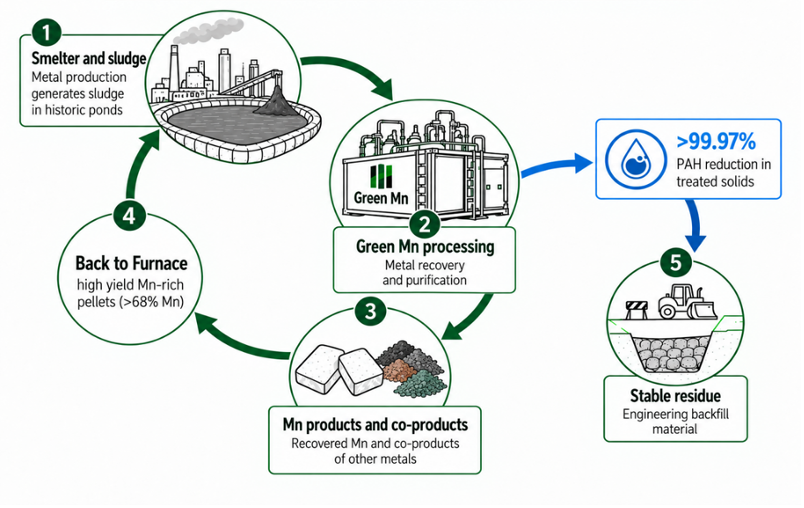
This closed-loop model converts compliance liabilities into opportunities for improved operating margins through secondary metal recovery, reduced waste-management costs, and more efficient smelting operations.
Next Steps & Industrial Collaboration
Upcoming scaled-up trials will focus on further optimizing manganese extraction, refining co-metal recovery circuits, and qualifying recovered manganese pellets for industrial smelting applications.
Green Manganese welcomes discussions with ferroalloy producers and industrial partners interested in evaluating their gas-cleaning sludge, smelter dust, and historical residue deposits for on-site processing and metal recovery.
About Green Manganese Technologies Inc.
Green Manganese Technologies Inc. is a Canadian mineral-processing technology company developing a proprietary hydrometallurgical platform to recover manganese and critical co-metals from industrial residues, mining tailings, low-grade ores, and polymetallic feedstocks.
The company’s modular systems support circular industrial production, lower-emission metallurgy, and resilient domestic critical mineral supply chains.
Media and Partnership Inquiries
Maria Poltorak
Green Manganese Technologies Inc.
maria@greenmanganese.com